 TAK CRYSTALPURE ELEGANCE · GLOBAL VISION
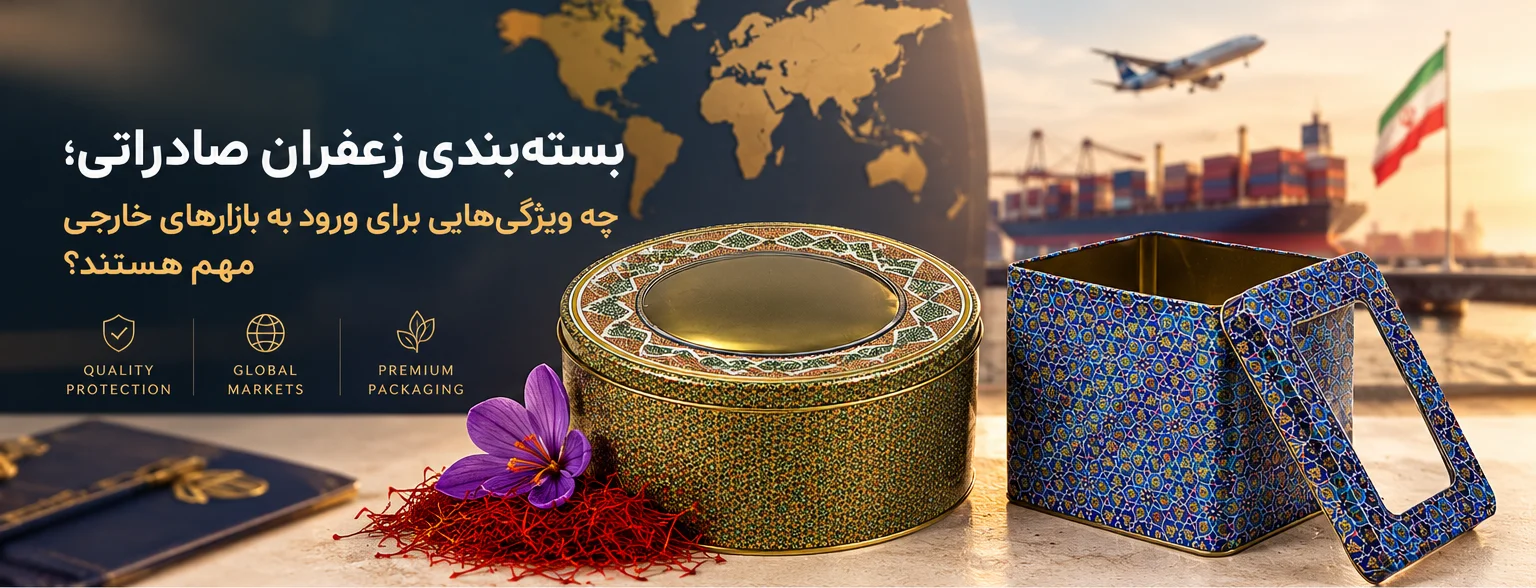
Iranian saffron can be a valuable and distinctive product on international markets, but for a successful presence abroad the quality of the saffron itself is not the only deciding factor. Export saffron packaging must protect the product, display the required information accurately, match the tastes of the target market's audience, and perform acceptably during transport and storage. For this reason, choosing an export saffron container should be part of the brand's overall plan for foreign sales, not a decision made solely on the container's appearance or price.
Producers planning to export usually face questions such as choosing between metal and crystal containers, designing packaging for Arab countries, printing information in the destination language, and selecting a packaging supplier. In this guide, we review the most important points in choosing saffron packaging for export and explain how to strike a balance between product protection, a professional look, target-market requirements, and final cost.
Why Does Export Saffron Packaging Matter?
Packaging is the first part of the product a buyer encounters. In a competitive market, a well-designed container can help build brand recognition, create initial trust, and set the product apart from similar options. However, a beautiful appearance alone is not enough; the container must be compatible with the product and protect the saffron against environmental factors and damage caused by handling.
Saffron is sensitive to storage conditions, and its aroma, colour, and quality must be preserved until consumption. Choosing unsuitable packaging, an unreliable lid, or weak secondary packaging may increase the likelihood of moisture ingress, air contact, physical damage, or quality loss along the distribution route. Therefore, when choosing export saffron containers, both the features of the container itself and the way it is placed in the master box and shipping carton should be evaluated.
1. Make Protecting the Aroma and Quality of Saffron a Priority
The first task of packaging is to help maintain product quality during storage and distribution. For this, features such as protection against light, moisture, and air ingress, the quality of the lid, and the compatibility of the container material with the product should be examined. The actual level of protection depends on the complete packaging design; therefore, a container being metal or crystal does not by itself guarantee longer shelf life.
When evaluating a container, pay attention to the following points:
- The lid must sit properly on the body and must not open under normal transport conditions.
- The material of the container and its inner coating, if any, must be suitable for the intended use and for possible contact with food.
- The internal dimensions of the container must match the weight of the saffron so that the product sits in it properly.
- If the saffron is placed in an inner layer or separate packaging, the compatibility of all components must be checked.
- Packaging performance should be evaluated with a real sample and under conditions close to the intended transport and storage.
For markets such as the European Union, materials and articles that come into contact with food must meet the requirements for the safety of food-contact materials. These regulations emphasise, among other things, the principle that packaging materials must not transfer their constituents to food at an unsuitable level or change its composition, smell, taste, or characteristics in an unacceptable way. Therefore, before a bulk order, you should obtain from the manufacturer the documents and technical specifications related to the container's food-contact use.
2. Choosing an Export Saffron Container: Metal, Crystal, or Custom Design?
No single type of container is the best choice for every brand and every export destination. The choice should be made according to the brand's positioning, budget, product weight, shipping method, market needs, and the technical features of each model.
Metal Saffron Containers
Metal containers can suit brands looking for packaging with a sturdy structure, a surface suitable for custom design, or a distinctive effect. However, final strength and performance depend on the exact metal, the coating, the body structure, the quality of the lid, and how the container is used. When choosing, examine the technical specifications and permitted use of each model, and do not decide based on appearance alone.
Crystal Containers
Containers sold on the market as crystal can differ in transparency, weight, strength, and manner of use, depending on the actual material. If the visual display of the saffron or the look of the product matters to the brand, this group can be one of the options to consider. Nevertheless, the actual material of the container and its suitability for food packaging must be confirmed; the market label “crystal” alone does not provide sufficient information about the composition of the materials or technical compliance.
Custom Containers and Multi-Part Packaging
Some brands need a particular size, shape, print, or packaging combination. In that case, looking into custom containers or using the container together with an outer box can help align better with the brand identity. Before custom design, coordinate the required print run, setup cost, production time, reorder possibility, and technical limitations with the manufacturer.
3. Export Saffron Packaging Must Match the Destination Market
The target market is not just the destination of the shipment; consumer taste, purchasing habits, language, the information required on the label, and import regulations also play a role in choosing packaging. Packaging suitable for a specialist Iranian-products shop may differ from packaging suitable for corporate gifts or a supermarket chain.
Before finalising the design, consider these questions:
- Does the end customer buy the product for everyday use or as a gift?
- Will the product be sold on a shop shelf, in an online store, or through a wholesale distribution network?
- Does the importer or retailer have specific restrictions on size, shape, barcode, or layout?
- Which languages are needed for the product name, label information, and marketing messages?
- Is the container design consistent with the brand's other products?
For export orders, it is better to review the design and technical specifications with the importer or distributor at the destination from the start. Changing the label or packaging after production can add cost and time, and in some markets label changes must be reviewed or approved before the goods arrive.
4. Saffron Packaging for Arab Countries: Pay Attention to Language and Regulations
For offering saffron in Arab countries, it is not enough to use colours or designs that are merely visually appealing. The label language, legibility of the text, product information, and the suitability of the promotional message for the destination market must be considered from the design stage. Bilingual Arabic-and-English packaging may be practical in some markets, but the exact requirements must be checked for the country in question; Arab countries are not a single unified market with completely identical regulations.
For example, the trade guide for the United Arab Emirates explains that food labels must be in Arabic or in Arabic and English, and must cover information such as the product name, ingredients, country of origin, and storage conditions or directions for use where applicable. The guide also points to the need to pay attention to production and expiry dates on the main label and to check label approval. In Saudi Arabia as well, the labels of packaged food products must comply with the regulations on food information and provide Arabic information; if another language is also used, it must be placed alongside Arabic in accordance with the requirements of the destination market. Details may change, so before final production, take the importer and the official authorities of the destination country as your basis.
When designing the Arabic version, entrust the translation to a translator familiar with food terminology, and after layout, check the text for right-to-left direction, spacing, numerals, legibility, and consistency with the other version. Using machine translation without human review may lead to errors in the product name or essential information.
5. Define the Label Information Before Final Production
One of the costly mistakes in saffron packaging for export is finalising the container and print before the label content has been determined. The usable space on the container is limited and must be planned from the start for the essential information and the brand identity elements.
Depending on the destination country's laws and the type of product, the required information may include the exact product name, net weight, country of origin, the name and address of the manufacturer or packer, batch or production-series number, relevant dates, storage conditions, importer information, and barcode. This list is a general checklist and does not mean that all items are equally required in all countries. Final responsibility for confirming label requirements should be coordinated between the exporter, the importer, and a regulatory consultant familiar with the destination market.
Place the information so that it remains legible and does not interfere with the edges, seams, or curved parts of the container. If variable information such as the batch number or dates is to be printed later, the location and method of printing them must be determined before production. Do not sacrifice enough space for the necessary information in order to enlarge the logo or decorative elements.
6. Professional Design, High-Quality Printing, and a Unified Brand Identity
Export packaging must be both practical in terms of information and convey the brand identity in an orderly way. A legible logo, a limited and harmonious colour palette, suitable contrast between text and background, and avoiding visual clutter help the customer recognise the product more quickly.
The printing method should be chosen based on the container's material, surface shape, design, number of colours, and print run. For some designs, hot-foil printing can highlight selected details; pad printing may be worth considering for some surfaces or small print areas; and silk-screen printing is also a practical option for certain surfaces and colour designs. Whether each method can be carried out depends on the actual container model and its technical specifications, and it must be tested before a bulk order.
Approve the final sample before mass production begins. At this stage, the colour, dimensions and logo placement, text clarity, print quality, lid condition, and the overall appearance of the container are checked. A verbal approval or viewing the design on a screen is not a substitute for a printed sample on the actual container.
7. Do Not Forget Secondary Packaging and Transport
Even if the primary container is well designed, weak outer packaging can damage the product during export. Containers must be arranged in a suitable box or carton so that they do not experience excessive movement or impact. The choice of dividers, cushioning, the number of containers per carton, and the arrangement must match the shape and weight of the product.
Before sending a large order, check how the cartons are arranged and how much pressure they can withstand. If the shipping route is long or the goods are handled several times, the packaging must be evaluated under real distribution conditions. The dimensions and weight of the final carton can also affect warehouse space, shipping cost, and the ease of counting and checking the order.
It is useful for exporters to show the final packaging sample to the importer and get feedback on the number of units per carton, the arrangement in the warehouse, and the requirements of distribution centres. This review is especially important when the container has a special shape or a raised lid.
8. What Criteria Matter When Choosing a Manufacturer of Export Saffron Containers?
Choosing a manufacturer of export saffron containers should go beyond comparing unit prices. Consistent quality at high print runs, the possibility of reordering, product variety, printing services, delivery time, and transparency in providing technical specifications all play a part in the successful execution of an order.
Before placing the order, clarify these points:
- A real sample of the container and its technical specifications should be available for review.
- Production capacity and the minimum order quantity should be specified.
- Printing methods and their practical limits should be confirmed for the container model.
- The cost of moulds, setup, or custom printing should be stated transparently.
- The schedule for production, quality control, and delivery should be defined.
- The possibility of resupplying the same model in future, and any likely changes to it, should be made clear.
- Documents on the container's use for food packaging should be reviewed according to the needs of the target market.
The Tak Crystal website presents itself as a manufacturer of saffron and dried-goods packaging containers and displays categories including metal, crystal, vacuum, and custom containers. The company introduction also mentions hot-foil, pad, and silk-screen printing services. To choose a suitable export model, it is better to enquire directly about each product's specifications, the printing possibilities on that same model, and the terms of bulk orders.
9. Common Mistakes in Saffron Packaging for Export
A few seemingly simple decisions can become costly later. Choosing a container purely on appearance, ignoring food-contact documents, not approving a printed sample, printing information in a very small font, and leaving label translation to the last stage are among the most common mistakes.
Another mistake is using a single packaging design for all markets without checking the regulations and the expectations of customers at the destination. Sometimes a limited change in language, the placement of information, or text size is needed; sometimes the importer also has specific requests for the barcode, outer packaging, or arrangement. It is better to clarify these points before a bulk order.
Also avoid including claims such as “completely moisture-proof,” “suitable for food contact,” or “recyclable” without having the relevant documentation. Every technical or environmental claim must be consistent with the product's actual characteristics and with reliable documents.
Final Checklist for Choosing Export Saffron Packaging
Before confirming the final order, review this checklist:
- The destination market and the importer's requirements have been identified.
- The material and use of the container for packaging the product have been checked.
- The quality of the lid and the required protection against environmental conditions have been assessed.
- The final design and the space needed for label information have been approved.
- The translation and the information of the destination version have been reviewed.
- The printed sample and the final packaging sample have been approved.
- Secondary packaging has been checked for arrangement and transport.
- The final price, print run, delivery time, and the possibility of reordering are clear.
Ordering Export Saffron Packaging Containers from Tak Crystal
The right packaging can help preserve product quality, create a unified identity for the brand, and present saffron more professionally in foreign markets. To choose correctly, you need to examine the material and model of the container, its dimensions, the quality of the lid, the printing method, the label information, and the shipping packaging together.
If you are looking for export saffron packaging containers for your brand, first define the destination market, the product weights, and the required print run. Then compare the available models in terms of technical specifications, the possibility of custom printing, cost, and delivery time. Tak Crystal presents metal, crystal, vacuum, and custom containers in its product categories and also offers a variety of printing services; to choose a suitable model, enquire about the specifications and the feasibility of applying your design to the container you have in mind.
Placing an order will be more reliable when the final sample is approved before mass production and the details of printing, secondary packaging, print run, and delivery are clear from the start. This approach helps ensure that the chosen packaging not only looks right but also fits the real needs of the brand and the destination market.
Frequently Asked Questions About Export Saffron Packaging
What features does the best export saffron container have?
The best option depends on the destination market, the product weight, the target cost, and the container's technical specifications. In every case, compatibility with food use, a suitable lid, the required protection, a legible design, and the ability to be transported safely are important criteria.
Is a metal container suitable for packaging export saffron?
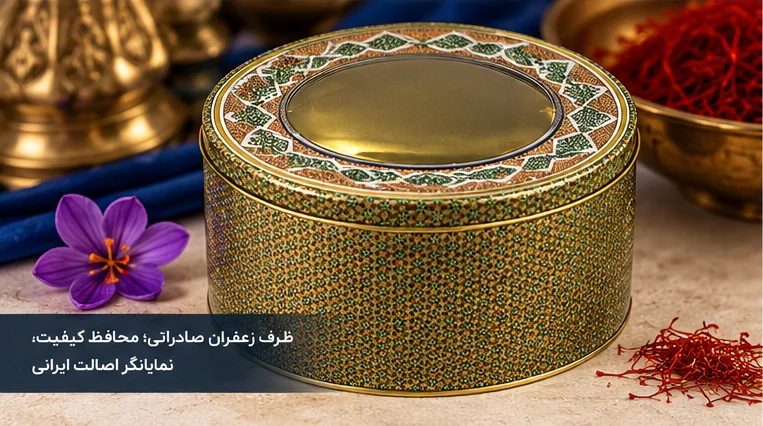
A metal container can be one of the options, but its suitability must be assessed based on the type of metal, the inner coating, the build quality, the type of lid, and the requirements of the destination market. The material of the container alone does not guarantee the performance of the packaging.
What is most important when packaging saffron for Arab countries?
The language and content of the label, the legibility of the information, correct translation, and compliance with the requirements of the destination country are highly important. Regulations are not the same across Arab countries; therefore, each country's requirements should be checked with the help of the importer or an official authority.
Can one packaging design be used for all foreign markets?
The brand's core visual identity can remain constant, but the language, label information, barcode, or some packaging details may change for different markets. It is better for the destination version to be approved before final production.
What should we ask the manufacturer for when buying export saffron packaging containers in bulk?
Ask for a real sample, technical specifications, information on the container's food-grade use, printing options, the minimum print run, setup costs, delivery time, and the terms of reordering. Reviewing these points before mass production prevents disagreements over delivery time or the final result.